What Should You Put on a Dog ID Tag in Australia?
Share
Quick answer: Put your dog's name and your mobile phone number on their ID tag, and consider adding a second number. In NSW, the Companion Animals Act 1998 says a dog must wear a collar with a name tag showing the dog's name and the owner's address or phone number, with some exceptions such as when the dog is on its owner's property. A tag works alongside, not instead of, a microchip and registration.
An ID tag is the quickest way for a stranger to get your dog home. No scanner, no app, no trip to the vet. Just a phone call. So what you put on that little tag really matters.
What should I put on my dog's ID tag?
Space is tight, so focus on what helps a finder reach you fast:
- Your dog's name. In NSW this is required by law, and it helps a finder calm your dog by calling them.
- Your mobile number. This is the most important detail. Use a number you will always answer.
- A second number, if it fits. A partner or family member is a good backup if you are out of range or your phone is flat.
- A short note, if needed. "Needs medication" or "Microchipped" can be useful extras.
RSPCA NSW advises making sure your pet's collar has a tag displaying your contact information, and also suggests including the microchip and registration number.
What does NSW law say about dog ID tags?
Section 12 of the NSW Companion Animals Act 1998 says a dog must have a collar around its neck with "a name tag that shows the name of the dog and the address or telephone number of the owner of the dog".
The rule does not apply while the dog is on property where its owner lives, and working dogs are also exempt. Not complying is an offence, so if your dog is out and about, at the beach, in the park or on a walk, the tag should be on.
Laws can change, so it's worth checking the current version of the Act on the NSW Legislation website or with your local council. Other states and territories have their own rules.
Should I put my address on my dog's tag?
NSW law asks for your address or your phone number, so you can choose. Many owners prefer a phone number only. It's quicker for a finder to call than to walk your dog to a street address, and it keeps your home address private.
What's the difference between an ID tag, a registration tag and a microchip?
These three are often confused, but they do different jobs.
- ID tag: A tag you buy, engraved with your dog's name and your phone number. Anyone can read it, which makes it the fastest way home.
- Council registration tag: Some states and councils issue a tag with a registration number. Rules differ around Australia. Our guide to dog registration and lifetime tags by state explains where they're used.
- Microchip: A tiny chip under the skin with a unique number linked to your details on a database. It can't fall off, but it needs a scanner, usually at a vet, council or shelter.
In NSW, Service NSW says all pet dogs and cats must be microchipped and registered on the NSW Pet Registry, and that registration covers your dog for its lifetime, even if its owner changes.
Is a microchip enough on its own?
A microchip is essential, but it only helps once someone takes your dog to be scanned. It also only works if your details are current. The RSPCA says it's very important to keep your contact details up to date on the database, especially when you move or change phone numbers.
A tag lets a neighbour ring you within minutes. That's why a tag and microchip work best together. We cover this in is a microchip enough to find a lost dog.
Can I use an AirTag as well as an ID tag?
Yes, and many owners do. They do different jobs:
- The ID tag helps a stranger contact you.
- The AirTag helps you see where your dog was last detected, using Apple's Find My network.
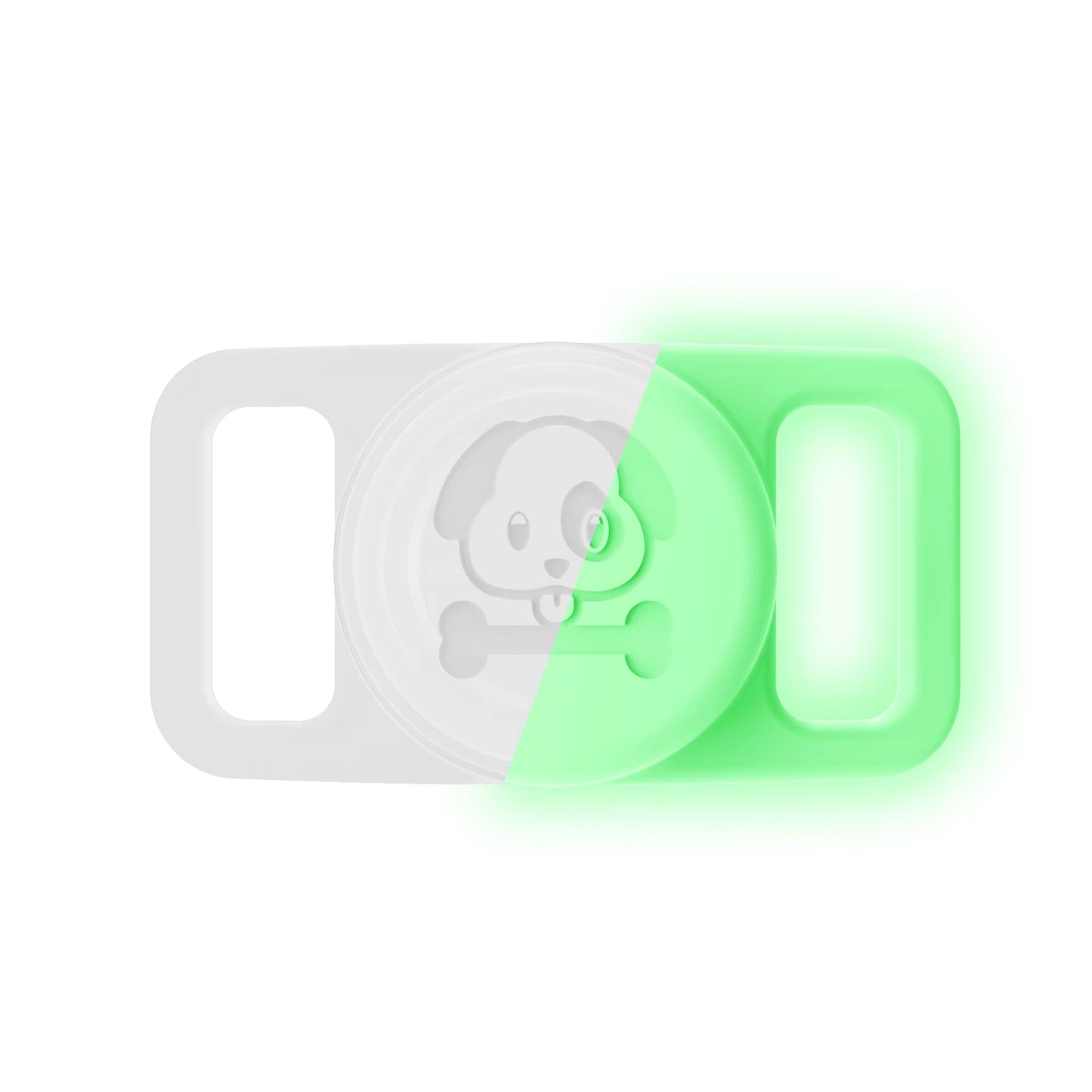
An AirTag is not GPS and doesn't replace a tag or microchip. If you mark it as lost, though, anyone with an NFC-capable phone can tap it to see your contact message, which adds another layer of ID. A holder such as the Pawfetchers waterproof AirTag holder sits on the collar next to your name tag, fitting collars 15 to 25mm wide.
If you are fitting one for the first time, see how to fit an AirTag holder to a dog collar.
Checklist: your dog's ID set-up
- Engrave a tag with your dog's name and your mobile number.
- Check the engraving is still readable every few months, as tags wear down.
- Make sure your dog is microchipped and registered on the NSW Pet Registry.
- Update your details on the registry whenever you move or change numbers.
- Add an AirTag in a secure holder if you want an extra way to locate your dog.
FAQs
Is it a legal requirement for dogs to wear ID tags in NSW?
Yes. Under section 12 of the Companion Animals Act 1998, a dog must wear a collar with a name tag showing its name and the owner's address or phone number. Exceptions include when the dog is on its owner's property and working dogs.
Should I put my dog's name on the tag?
In NSW, yes, because the law requires it. It also helps a finder calm your dog by using its name.
Does a microchip replace an ID tag?
No. A microchip needs a scanner to read, while a tag can be read by anyone. In NSW you also need the name tag by law when your dog is off your property.
Can an AirTag replace my dog's ID tag?
No. An AirTag is not a name tag and doesn't meet the NSW tag requirement. Use it alongside your dog's ID tag and microchip.
Where do I update my dog's microchip details in NSW?
Through the NSW Pet Registry, or by contacting your local council if you can't do it online.
Add an extra layer of peace of mind next to your dog's ID tag with the Pawfetchers AirTag dog collar holder (AirTag sold separately).